
The Problem & Motivation:
Directly imaging exoplanets requires extremely high-contrast coronagraphs to suppress starlight, which can be billions of times brighter than the planet. This suppression demands sub-micron alignment precision of optical masks and deformable mirrors (DMs). Manual alignment is slow, error-prone, and lacks repeatability. This package was developed to automate these critical alignment and calibration procedures, ensuring the accuracy and repeatability required for instruments like NASA’s Nancy Grace Roman Space Telescope Coronagraph Instrument.
Key Features:
Deformable Mirror (DM) Registration: Implements algorithms to precisely determine the position, clocking, and scaling of DM actuator grids relative to the optical beam using phase retrieval data.
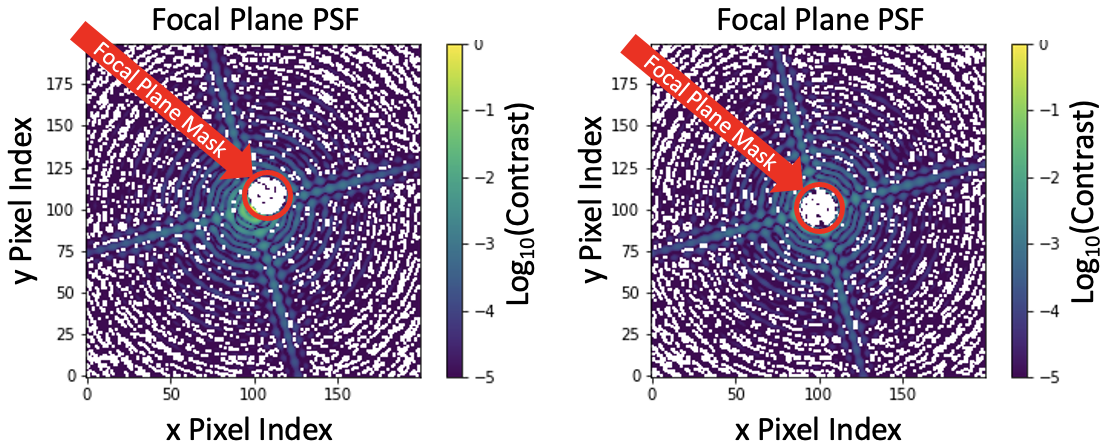
Automated Mask Alignment: Provides routines for the sub-pixel alignment of various coronagraphic masks, including pupil masks (apodizers, Lyot stops) and focal plane masks (occulters).
Wavefront Flattening: Uses registered DM positions to correct wavefront errors, decomposing aberrations using Zernike polynomials and allocating corrections to the DMs to achieve a flat starting wavefront.
Astrometry & Calibration: Includes functions for astrometric calibration (occastro) and plate scale solving (platesolv) using DM-generated satellite spots.
Tech Stack & Implementation:
The package is built in Python, leveraging NumPy and SciPy for numerical computation and Astropy for FITS file I/O. As a contributor, I helped establish a robust software development lifecycle by implementing a comprehensive unit test suite with pytest (following Test-Driven Development principles) and configuring the Continuous Integration (CI) pipeline using GitHub Actions to ensure code reliability.
My contributions to the utility library include implementing core alignment algorithms, such as the model-free center_of_energy method for focal plane alignment. I also integrated the OpenCV (cv2) library to provide fast, robust circle and ellipse fitting for mask detection. To improve the project’s accessibility and demonstrate key features, I also developed a series of interactive Jupyter Notebooks runnable in Google Colab.
Resources & Citation
A. J. Eldorado Riggs, Michael Bertagna, Garreth J. Ruane, Eric J. Cady, David S. Marx, Sam P. Halverson, Samuel Miller, Kevin J. Ludwick, “Coralign: a software package for coronagraphic alignment and calibration,” in Proc. SPIE 12680, Techniques and Instrumentation for Detection of Exoplanets XI, 126802F (5 October 2023). doi:10.1117/12.2677703